The Enormous Radio Q+A with Roslyn Oades, Bob Scott & Sarah Walker/
FOREWORD FROM BOB SCOTT (CO-CREATOR & SOUND ARTIST):
Humans need to understand things. We are a making sense machine.
So, when we are confronted with sensory information (sound for example) that we don’t immediately understand, our instinct is to make explanations in order to understand what we are experiencing.
We anthropomorphise animals and the sounds that they make in order to try to understand what they are saying.
We anthropomorphise the radio static, and reconstruct sonic artifacts in the noise that may or may not have been there in the first place.
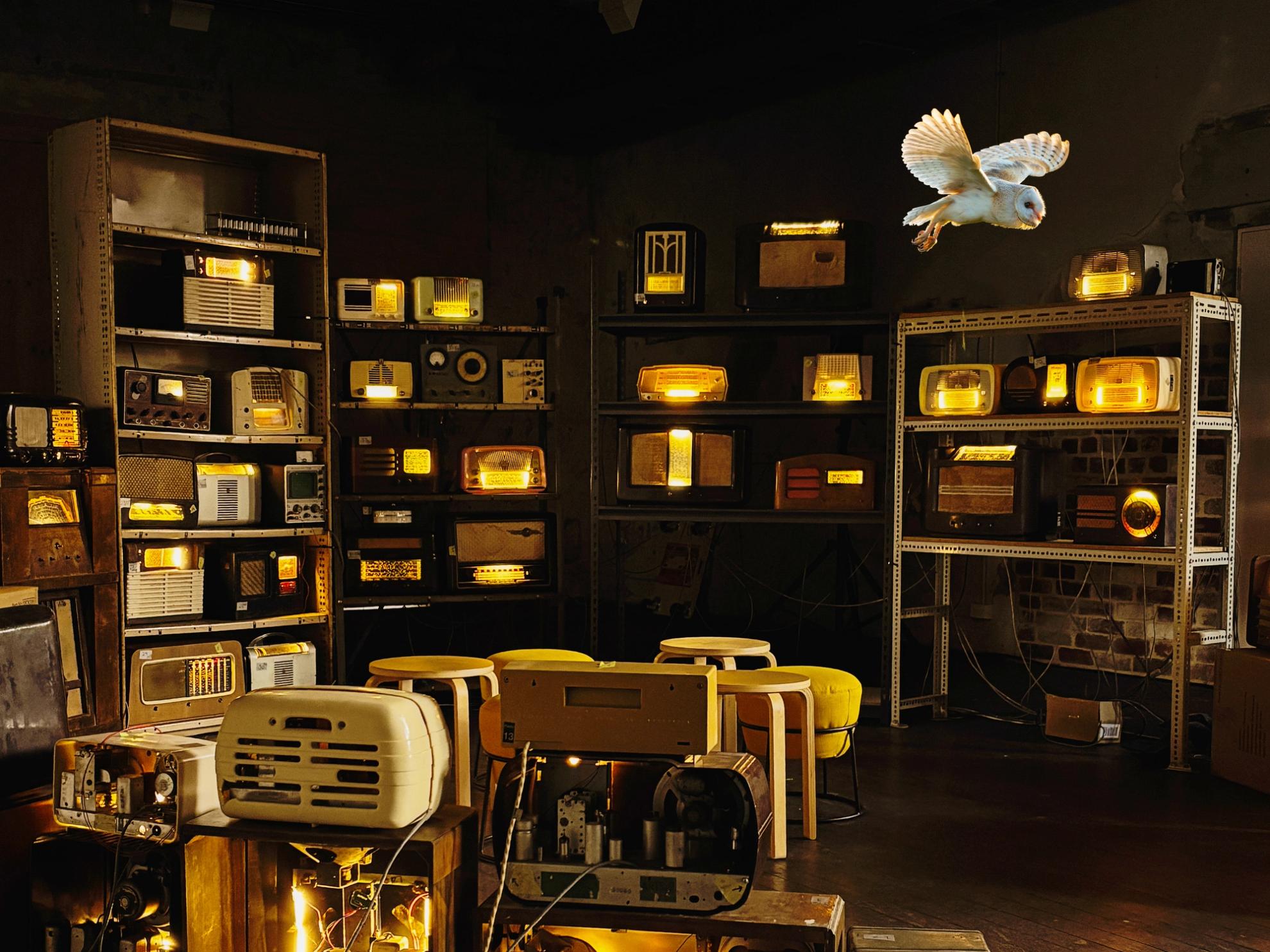
The Enormous Radio is a parallel intelligence – a machine that has evolved to deduce its own logic from invisible sound and radio waves.
Incomplete fragments of an urgent message.
Or is it all just noise?
And why the old radios? Maybe they are a comment on evolution, perhaps evolutionary dead ends?
Not long after the domestication of electricity, a state of the art- scientific instrument was invented to pull sound out of the ether and present it to us, in the comfort of our living rooms for our entertainment.
These devices are all but extinct now - a distant memory - unwanted and neglected by modern society.
But time doesn't stand still, not even for 1930s glass and Bakelite based sentient life forms.
While the humans have been doom-scrolling, wild animals have moved in and taken over what we've left behind, in a desperate, last-ditch attempt to tell us something critically important.
If only we would listen!
---------------------------------------------------------------------
THE SUBSTATION: Roslyn, your background is in documentary theatre. How did those documentary instincts influence a work without conventional human subjects?
ROSLYN OADES (CO-CREATOR/THEATRE-MAKER): In my practice as a documentary theatre and audio-maker, I’ve pursued an interest in the unique qualities of human speech patterns – which has involved interviewing hundreds of people. However, over the last few years, I’ve become increasingly fascinated with the mysteries of animal vocalisations – and the unbridgeable interspecies communication gap between us.
My research on this project has involved learning field recording techniques and becoming a member of the Australian Wildlife Sound Recording Group.
Something I love about working with documentary source materials is the forms’ ability to speak to the here and now of life in Australia in a very present and resonant way. With advances in machine-learning and digital recording technology, acoustic ecologists are currently making astounding inroads into decoding animal communication patterns – Sperm whale families being a prime example.
The idea of technology unlocking a mystery of this nature is mind-blowingly wild to me – and opens a lot of complex and haunting questions. In a way, this work is a way processing these ideas while also exploring a genuine human desire to connect with the wild and unknowable.
What are some of the Australian wildlife field recordings will we hear, and how have some of their languages been translated or transmitted?
ROSYLN OADES: The Enormous Radio is structured as a series of haunted broadcasts. Each of these transmissions attempts to tune into and translate the vocalisations of a different Australian wildlife species. The featured animals include: Tasmanian devils, Pobblebonk frogs & March flies, Red-tail Black Cockatoos, Blue whales, Dingoes and Boobook owls.
To create our uncanny animal translations, we put these field recordings into human voice enhancement software with the instruction to clean up ‘a human speech recording’. Through this misuse of this technology, the software found and excavated English-language words from the animal recordings – that sound part human, part animal. As a documentary-maker these found texts were very compelling artefacts to work with – and somehow speak to the environmental mangle we find ourselves in.
I think it enriches the experience to know that no ‘animal translation text’ in the work has been made up. These uncanny texts are all genuine machine translations extracted from original wildlife field recordings – using readily-available human voice enhancement and translation software.
SARAH WALKER (TEXT DRAMATURG): We have a number of stunning recordings, from the very small (march flies buzzing), to the colossal (blue whales calling underwater), as well as a stunning recording of dingoes singing together in a gorge. They were all captured by members of the Australian Wildlife Recording Group, of which Ros is a member. It was important to us that all of the recordings were documentary ones.
We have then mistreated these recordings through a series of technical processes — firstly, by running through Adobe Podcast's voice enhancement software. Because the software presumes that the information fed into it is human voice, it produces these fascinating, slightly glitchy results that sound half-human, half-animal. We then run these through transcription software, which finds text within the blurps and bleeps. By misusing these pieces of software, we lean into the idea of seeking retrievable communication from the nonhuman.
The Enormous Radio repurposes old technology, but the work feels very contemporary. Why was radio the right metaphor and medium for this project?
ROSLYN OADES: Last year was the 100th year of radio broadcast in Australia – and to this day, is still relied on in times of natural disaster, such as bushfires and floods. However, it’s also quickly becoming superseded by podcasts and apps. As artists, Bob [Scott] and I are very interested in the idea of the obsolete and what gets left behind as a reoccurring motif.
For an environmental perspective, I find the built-in obsolesce of modern machines and our normalisation of throw-away culture very disturbing. Items that have been in service to humans for so long, also feel like the perfect vessels to invest ideas of machine-sentience and hauntings. Perhaps they understand us more then we realise.
SARAH WALKER:
Every time humanity invents a new technology, there is an accompanying interest in the idea that this new technology might have expansive powers and capacities, particularly those of a spiritual or occult nature.
The rise of photography was accompanied by an interest in spirit photography; when the radio was popularised, so too was the process of EVP (electronic voice phenomenon), where users tune between channels to try to pick up transmissions from ghosts or aliens. There is something very moving about this: the idea that technology is a way to manage grief, loss and the feeling of being alone in the universe.
Radio is a mode of communication, of bringing the voice close. The Enormous Radio expands this idea: what if the voices that were transmitted to us are nonhuman ones? The work engages with the feeling of being isolated, atomised and disengaged from the so-called 'natural' world, and uses the human sense of isolation within the animal ecosystem as a jumping-off point for exploring the urge to connect. The radio is the perfect medium for that.
This isn't a performance that unfolds in one direction, it's an installation people inhabit. How does that change your thinking as makers?
ROSLYN OADES: I’m very interested in the idea of expanded-theatre at the moment, by which I mean taking my theatre making skillset into other creative forms. Bob has already worked extensively as a sound artist in the visual arts world, and I think we make for good co-creators as we both approach the making of the work quite differently. Bob is thinking about compositional forms and I am thinking about liveness. The Enormous Radio is a meeting of these two approaches.
We’re also excited to be working with production designer Jen Hector and technology designer Kevan Atkins, to imbue our large radio hive with a séance-like liveness. The radios themselves, were designed as live broadcasters – they also have a lot of personality – so there’s a lot to play with as a theatremaker. Our shared vision is to create a living, breathing sentient techno-Frankenstein.
Can you share any interesting animal or wildlife facts for some of the animals featured (or even how their calls were captured)?
ROSLYN OADES: As a doco artist, I love cool facts, so thanks for asking! Here are some interesting facts about our hero animals…
Fav Tassie Devils facts:
- Most of the vocal noise produced by devils is a result of raucous communal eating, at which up to 12 individuals can gather; it can often be heard several kilometres away.
- Devils are known to return to the same places to defecate at a communal location, called a devil latrine. Communal defecation may be a means of communication that is not well understood.
- They’re known as "purinina" in traditional Palawa language
Fav Pobblebonk frog facts:
- They called “pobblebonks” because of the distinctive "bonk" call they make, which sounds a bit like a banjo string being plucked. They’re also sometimes called Banjo Frogs or Bull frogs.
- They’re a borrowing frog and they also call to each other while underground.
- They are my all-time favourite Australian frog song
Cool March fly facts:
- Okay, least favourite animal in the work, as their bites really hurt (FYI: only the females bite. They’re extracting your blood to provide protein for their eggs)
- Australian March flies are known for being extremely noisy during flight
- They’re the fastest known flying insects - males have been recorded reaching speeds of 145 km/hour when pursuing a female
- Lifespan is 3-4 weeks (explains why they’re in such a hurry)
Fav Red-tail Black Cockatoos facts:
- Beautiful almost dinosaur-sounding birds, who are under threat due to deforestation
- Almost exclusively left-footed
- They are characteristically raucous and noisy and hang out in a rowdy gang.
- They have several vocal calls: the contact call is a rolling metallic krur-rr or kree, which can carry long distances and is always given while flying; its alarm call is sharp. Displaying males vocalize a sequence of soft growling followed by a repetitive kred-kred-kred-kred
- They tend to fly rather slowly with intermittent deep flapping wingbeats.
Blue Whales facts:
- Our amazing Blue Whale recordings were kindly provided by Dr Brian Miller and team at the Australian Antarctica Division, who have a continuous digital recorder positioned on the ocean floor off Herd Island (between Tasmania and Antarctica)
- Blue whales are the largest known animal to have ever existed on earth (recorded lengths of over 30m). They are lunge feeders and need to eat around 4 tons of krill a day
- Blue whales produce some of the loudest and lowest frequency vocalisations in the animal kingdom, and their inner ears appear well adapted for detecting low-frequency sounds
- Their vocalisation frequencies range from 8 to 25 Hz, with a maximum loudness of 188dB
- They have two blowholes that can squirt 9.1–12.2 meters up in the air.
- Research has shown that blue whales are sensitive to mid-frequency active sonar and move rapidly away from the source of the sonar, a response that disrupts their feeding and can cause mass strandings.
Dingoes:
- The name "dingo" comes from the Dharug language used by the Indigenous communities of the Sydney/NSW area.
- Wild dingoes howl in chorus with significant pitches, and with increasing number of pack members, the variability of pitches also increases. Their highly variable chorus howls are sometimes used to generate a confounding effect in the receivers by making pack size appear larger.
- Recently, the largest known population of critically endangered Night Parrots was discovered in an area kept free of introduced predators by dingos - as they're known to hunt many introduced and invasive species (e.g. wild cats, etc). So, dingos are endangered bird conservationists!
- In addition to Dingo Fences, poison 1080 (nicknamed "doggone") is still extensively used for "controlling" wild dingo populations in farming areas.
The Enormous Radio asks audiences to listen differently. What do you think we overlook in our everyday sonic environment?
SARAH WALKER: Sound is an interesting sense, because unlike vision, it is impossible to easily block out. We can't close our ears the way we close our eyes, and so our brains are adept at filtering out the vast majority of what we hear. We prioritise human voice and sounds that are germane to the task at hand, which means that we rarely pay attention to the 'noise bed' that surrounds us, both urban and environmental.
Is there a particular animal recording that affected you emotionally during the making of the piece?
SARAH WALKER: The recording of dingoes calling to each other in Ormiston Gorge is a particularly beautiful one. They are using the acoustics within the gorge to bounce their voices around, working with echo - it's a kind of concert, a performance. There is something incredibly moving, strange and beautiful about the idea of wild dingoes gathering for the sheer joy of making sound together.
The installation is structured as a seance, where the audience will be surrounded by "haunted transmissions". What role does the uncanny play in opening us to new ideas?
SARAH WALKER: As long as humans have existed, we have been drawn to the idea of enchantment within the world. The story of human history is one of myths and gods and superstitions - the feeling that actions and words have power, and that the unseen and unheard nevertheless impact us profoundly. In an age of climate emergency, the hyperobject of climate change (something so big it cannot be seen, touched or even fully comprehended) takes on the colossal quality of myth; it impacts us even though we can't hold it. The Enormous Radio plays with the slippage between comprehension and incomprehension that characterises our relationship with the nonhuman. The uncanny suggests that we might impact the world profoundly by attending to it deeply. Art, in that way, is like a spell or a ritual: it's a focussing, a concentration of energy and attention that allows new possibilities to emerge.